Google AI Unveils UCP for Next-Gen Commerce
Explore Google's Universal Commerce Protocol, aimed at revolutionizing AI-driven purchasing experiences.
What is the Universal Commerce Protocol (UCP)?
Can AI shopping agents move beyond sending product links and actually complete trusted purchases end to end inside a chat? Universal Commerce Protocol, or UCP, is Google’s new open standard for agentic commerce. It gives AI agents and merchant systems a shared language so that a shopping query can move from product discovery to an authenticated order without custom integrations for every retailer and every surface.
Addressing Integration Challenges
Today, most AI shopping experiences stop at recommendation. The agent aggregates links, you handle stock checks, coupon codes, and checkout flows on separate sites. Google’s engineering team describes this as an N by N integration bottleneck. Each new conversational surface requires separate work from every merchant and payment provider.
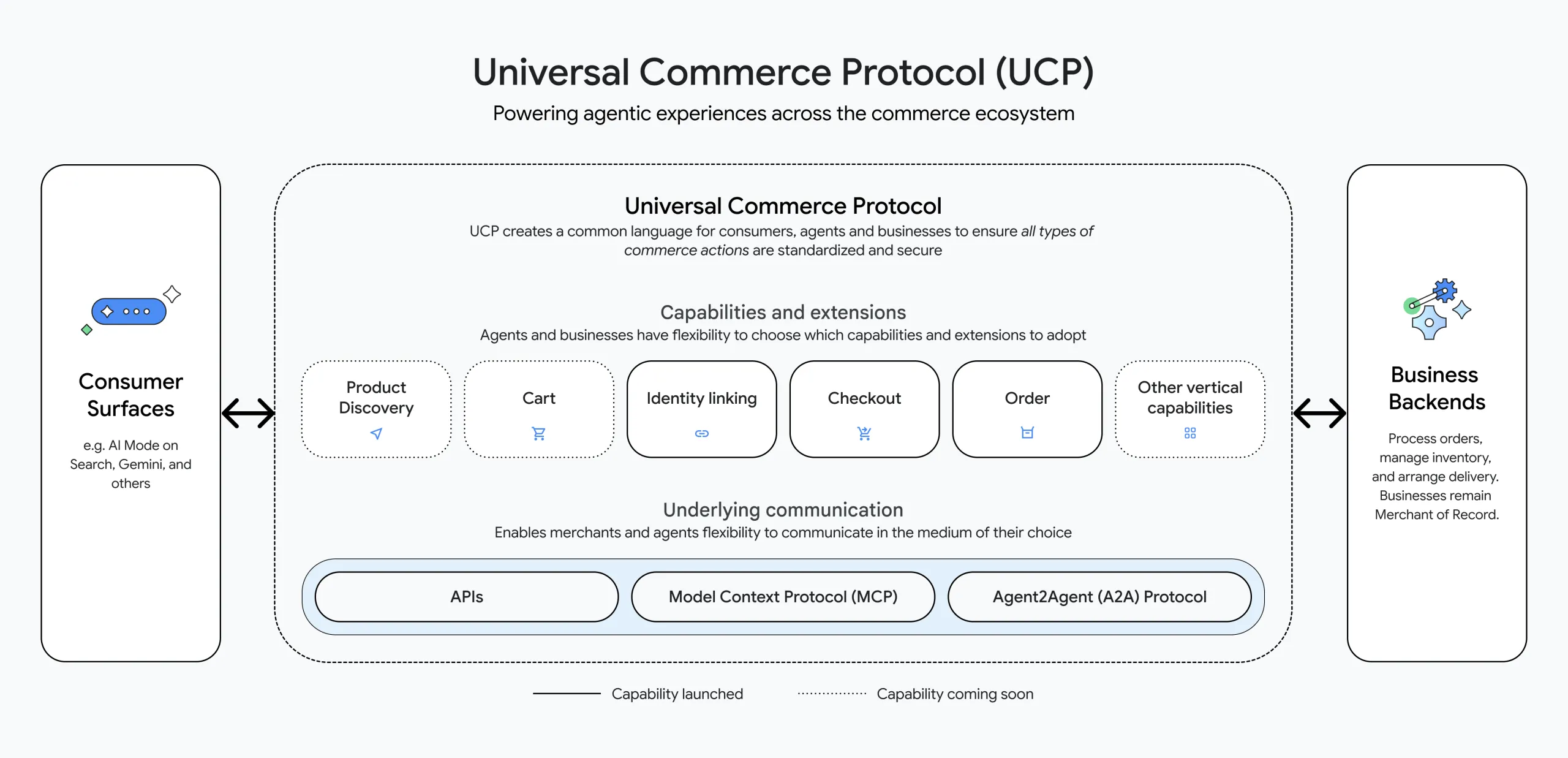
UCP collapses that to one abstraction. Platforms such as Gemini or AI Mode in Search integrate once with the protocol. Businesses expose their commerce behavior once behind UCP. Payment Service Providers and Credential Providers integrate at the payment layer. The same protocol can support many verticals such as shopping, travel, or services.
Key Constructs and Roles in UCP
The UCP core concepts document defines four primary actors:
- Platform: The agent or application that orchestrates the user journey (e.g., AI shopping assistants).
- Business: The merchant or service provider.
- Credential Provider: Manages payment instruments and personal data.
- Payment Service Provider: Processes authorizations, captures, and settlements.
Three fundamental constructs are introduced:
- Capabilities: Such as Checkout, Identity Linking, and Order.
- Extensions: Such as Discounts, which extend capabilities.
- Services: Bind capabilities to transports such as REST API.
Initial Key Capabilities
The GitHub repo lists four initial key capabilities for shopping:
- Checkout: Manages checkout sessions and cart contents.
- Identity Linking: Uses OAuth 2.0 to act on behalf of users.
- Order: Emits lifecycle events for shipment and refunds.
- Payment Token Exchange: Coordinates exchange between providers.
AI Agent Commerce Lifecycle
The Google reference implementation illustrates the UCP flow. A typical agentic checkout involves several steps, from fetching the business profile to routing payment through a handler that understands specific schemas.
From the user perspective, this keeps the entire flow in a single conversation with clear consent steps.
Security and Payment Protocols
The specification defines a transport layer with bindings for REST and other protocols. UCP integrates with the Agent Payments Protocol, ensuring the separation of payment instruments from handlers for secure transactions.
Key Takeaways
- UCP defines a common commerce language for AI agents and businesses.
- Co-developed with major partners, the protocol supports a wide range of commerce activities.
- Payments are managed securely, ensuring proofs of consent even in autonomous scenarios.
Сменить язык
Читать эту статью на русском